Subterranean termite soil barrier treatments in Los Angeles provide structural protection against Western subterranean termites, which establish underground nesting colonies in moist native soil and navigate into sill…
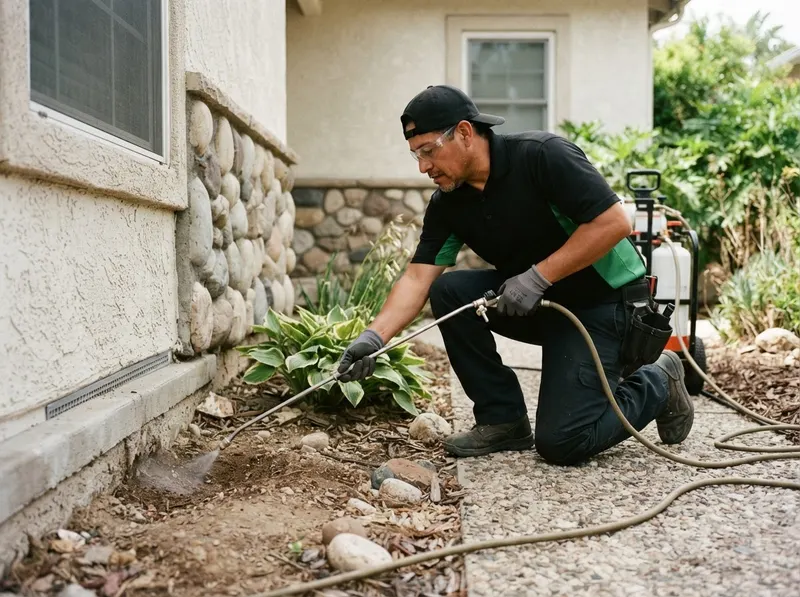
Subterranean termite soil barrier treatments in Los Angeles provide structural protection against Western subterranean termites, which establish underground nesting colonies in moist native soil and navigate into sill plates through foundation cracks as narrow as 1/32 of an inch. Unlike drywood varieties that remain isolated inside elevated framing, subterranean species require constant soil contact for moisture. Trenching along exterior stem walls to a depth of 6 inches and rod-injecting liquid termiticides, such as fipronil formulations, saturates the earth to create an undetectable bio-barrier. Foraging worker termites traverse the treated zone without detection, transferring the active ingredient to the broader subterranean colony via social grooming and food sharing within 60 to 90 days.
Foundation construction styles across Los Angeles County dictate barrier design. Raised-foundation properties common in Echo Park, Silver Lake, and Boyle Heights require double-sided management: continuous trenching along the exterior perimeter and manual crawlspace trenching beneath subfloor access points to protect pier posts. In contrast, slab-on-grade architecture common in Sherman Oaks and Brentwood requires concrete slab drilling through attached patios, carports, and interior expansion joints. Holes measuring 1/2 inch in diameter are drilled every 10 to 12 inches to inject termiticide beneath the concrete cap before receiving a masonry patch matched to the surface.
Liquid soil barrier treatments fit structures undergoing ground-up infestation management where the moisture interface cannot be structurally eliminated, serving as an alternative to external baiting stations. Bait systems require recurring station monitoring over 12 to 24 months, while a continuous liquid barrier provides immediate foundation protection lasting 5 to 10 years without requiring mandatory monthly inspection plans. Properties located near riparian microclimates or dense hillside soils, such as the oak-shaded ravines of Los Feliz and Highland Park or maritime zones near Venice and Pacific Palisades, experience elevated soil moisture that extends subterranean foraging windows, necessitating strict trench depth adherence to prevent premature wash-off.
Child and domestic pet safety intervals remain manageable through targeted ground placement. Because technicians inject the product directly into subterranean trenches and subsurface void spaces rather than aerating it into ambient living spaces, surface drift is strictly avoided. Treated soil trenches are immediately backfilled with clean soil, keeping the termiticide isolated below ground. Occupants and animals may remain inside the residence throughout the entire application, provided they avoid exterior perimeter work areas for 2 to 4 hours until the backfilled topsoil surface dries fully.
Every job gets a firm, written price after a free on-site visit.
Tell us about your subterranean termite soil barrier treatments job in Los Angeles and we'll send a clear, written quote, usually the same day.
 Windmill Pest Control